Thirty years in the making: Reimagining the commercial loan servicing experience for M&T’s customers.
One of M&T’s prioritized strategic initiatives, the Servicing Modernization program kicked off in early 2025 with the goal to replace three end-of-life loan servicing programs that support the bank’s largest customer obligations.
M&T’s employees who service commercial loans are currently working on green screen programs that are out dated and cumbersome. There are also minimal integrations across systems, which creates manual re-keying and re-work throughout the commercial loan servicing experience.
Due to the scale and level of customer impact that this modernization will cause, the need for a human centered approach was prioritized. With that in mind, our small but dynamic team of service designers and user experience researchers kicked off this program in partnership with the commercial cank to ensure customer-centric solutions that will live on beyond just Servicing Modernization.

Client
M&T Bank, specifically Commercial and Business Banking Clientele
Duration
3+ years, beginning in 2025
My Role
Program Experience Strategy Lead
Methodologies
OKR creation, qualitative research, value proposition, ideation workshop, opportunity prioritization, service blueprinting
The team
3 service designers
1 UX researcher
30+ product owners and business SMEs
Deliverables (ongoing)
User experience research, personas, current state service blueprint, future state experience strategy, experience strategy playbook(s)
Program development
Human centricity from the start.
We kicked off the program by hosting a two-day in-person visioning workshop in Buffalo, NY. We leveraged pre-existing program principles and desired outcomes to drive our conversations (below) and I led the team to start thinking big about the program’s vision and goals – not only to prioritize the work, but to leave feeling inspired and capable that the work will and can get done.
I encouraged the team to think beyond technical improvements and consider what the customer and business needs are, to cultivate a holistic and well-rounded foundation for the program to begin with. Over the course of the two days, we worked with our stakeholders to refine How Might We statements to expand upon our initial understanding of the business challenges to be addresses; crafted team charters for additional clarity of team responsibilities; and drafted 30, 60, 90 day roadmaps to prioritize near term activities.
Coming out of the workshop, our design team quickly discovered that the larger program was not organized in a way conducive for success. In other words, we were not organized in a way that prioritized customer needs, instead focusing on the technical and business needs of the system modernization. This sparked a clear need for experience strategy leadership and guidance to help shape the approach to the program with a customer-centric lens.
Program Principles & projected outcomes
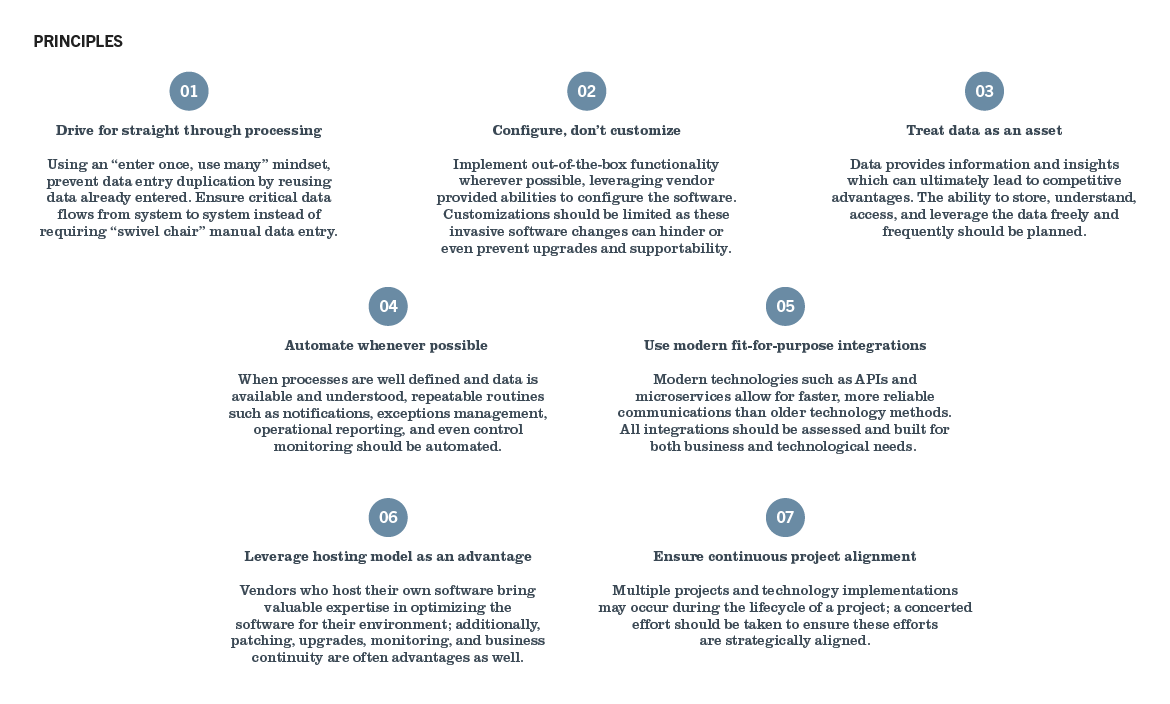
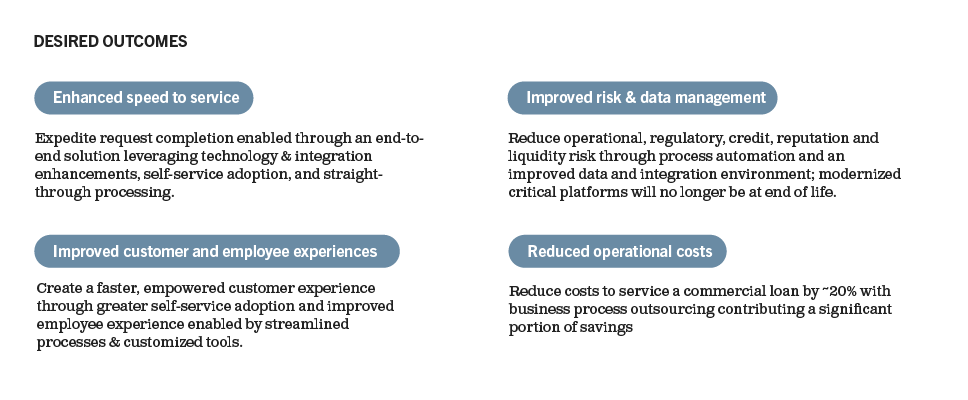
Taking a step back: the role of experience strategy.
This program was the first of its in kind at M&T in that the business (the commercial bank) prioritized the immediate collaboration between distinct teams – Commercial Banking and Transformation Enablement. The design team sits within Transformation Enablement, a department that serves to prioritize the customer throughout the bank by way of human-centered design thinking, change management strategies and agile practices. With this in mind, it was critical to define the design team’s role on Servicing Modernization in a way that enabled us to put forth the mindsets and practices of Transformation Enablement, and meet the expectations of the Commercial Bank throughout the life of the engagement and beyond.
My vision for the team was one of collaboration and empowerment – be partners with our business leads and empower them to learn about design thinking, all while equipping the team with tools to grow within their respective teams as we progressed throughout the engagement.
Despite being a smaller team of 4 (three designers and one UX researcher), we immediately immersed ourselves throughout the engagement with a designer on each work stream. I encouraged each designer to start with understanding the current state of that work stream, creating current state artifacts (journey maps, process maps, service blueprints, etc.) and to speak the same language with business partners – rooted in customer-centricity.
Continuous strategic support
Visualizing the end-to-end servicing experience.
Once our team was immersed in the program, we found a clear gap in the understanding of the end-to-end commercial loan servicing experience. Teams impacted by the Servicing Modernization engagement had siloed views of their involvement – for example, back-end operational teams were unaware of collateral regulatory requirements that were being asked of customers, which in turn caused delays for operational processing and potential negative customer experiences.
As the program lead, I set out to not only understand the end-to-end commercial loan servicing experience, but to visualize it in a way that was accessible and scalable for the team. I landed on leveraging a service blueprint that captured the journey of servicing a loan starting from booking and funding through maintenance. Because the program had never utilized an artifact like this, I worked closely with our executive business leads in bringing them along in the process – illustrating how an artifact like this creates shared understanding among teams and how findings from it may prompt strategic business recommendations.
Despite the blueprint being a living document, it has already been the catalyst for research efforts and prioritization activities across the program. This artifact has also prompted the creation of a “customer impact assessment”, which documents major internal and external facing impacts that may occur due to the modernization effort. This assessment supports the business in understanding what changes may occur and proactively address them to avoid any negative customer experience changes.
UX research.
In support of the current state understanding, we onboarded a user experience researcher to make informed recommendations based on our findings. Similarly to the service blueprint, the team was unfamiliar with the work and benefits of leveraging user experience research. To help build a solid foundation for our team, I partnered closely with our researcher and set the stage of what “good” looks like on the program – from creating research proposals, aligning on plans with executive leadership, maintaining transparent communication with business leads to share findings, making informed recommendations that align with the priorities of the business and customers alike.
One of the larger customer-facing impacts of the modernization effort to-date has been the change in look and feel of the monthly commercial loan statements. Our researcher interviewed 20+ client-facing employees and commercial loan clients to understand their current experience with their loan statements. Her findings prompted a complete redesign of the paper statements and sparked recommendations for leveraging existing online platforms so that clients may service their loan digitally, which has informed ongoing work around digital self-service.
looking to the future
what is to come?
2025 was truly a foundational year for the experience strategy team on Servicing Modernization. There is much more to come as the program progresses.
Throughout 2026, I see our team continuing to refine the customer impact assessment in close partnership with the change management practitioners to preemptively plan and mitigate any customer impacts (positive or negative). I also believe that we will have enough data to complete a thorough future state storyboard, which would serve to illustrate the ideal future state customer experience to come from Servicing Modernization. This would ideally support executive leadership to visualize strategic recommendations and encourage further buy-in of the experience practice. I would also like to partner with the design team to build an experience strategy playbook, setting the tone for future engagements that leverage experience strategy – outlining successes, expectations, and case studies for other teams to learn from.